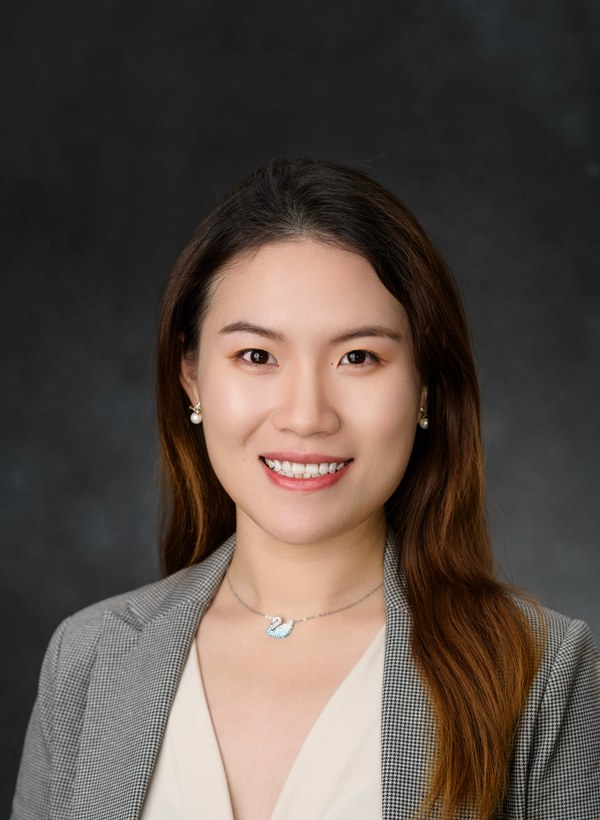
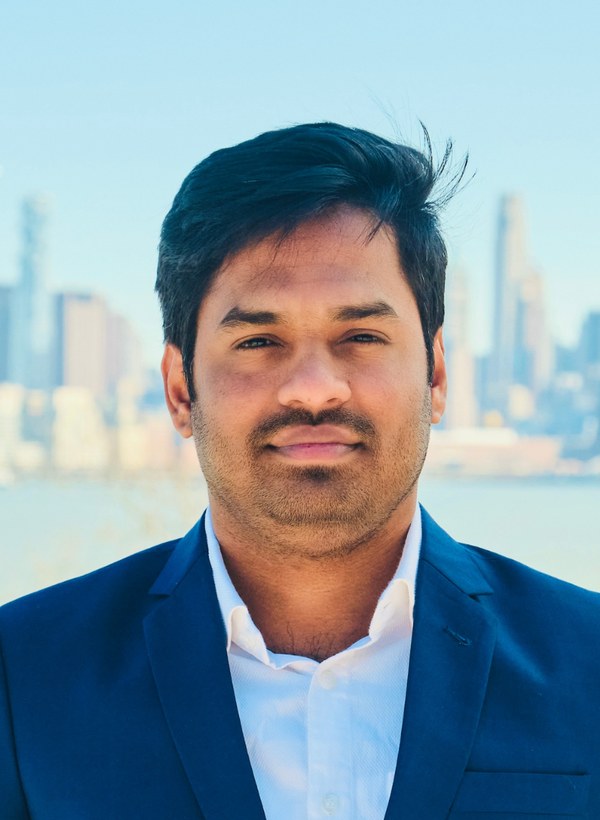
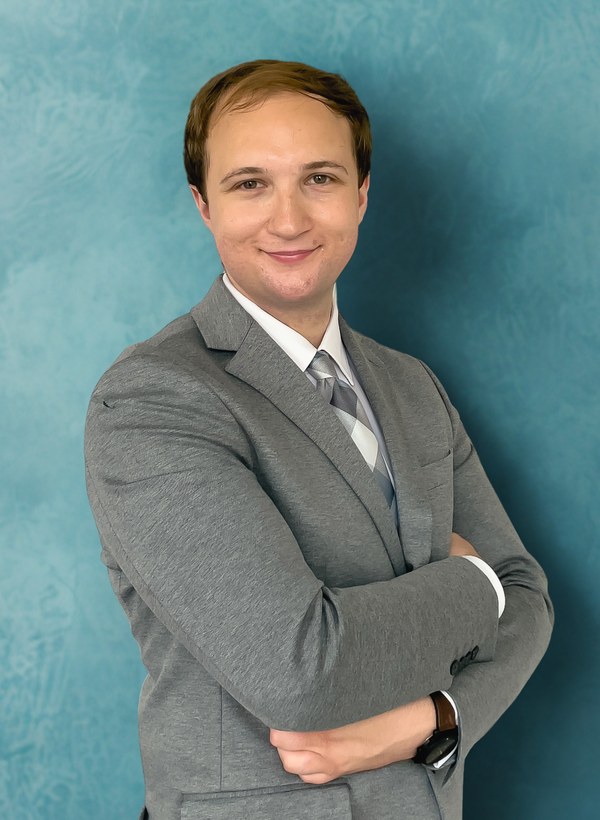
Interactive Computing Lab

Designing Accessible Interactions with Emerging Technology

About us

We are a Human-Computer Interaction research lab in the Department of Computer Science at Stevens Institute of Technology, directed by Dr. Jonggi Hong. Our mission is to design and evaluate accessible interactions with emerging technologies, from wearables and smart glasses to AI-infused applications, so that the people who are too often designed for last become the people we design for first.
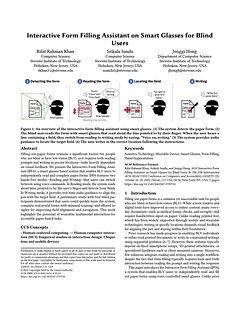
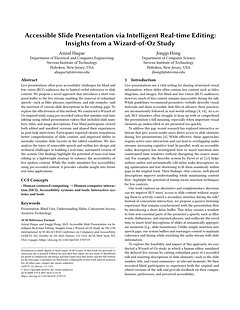
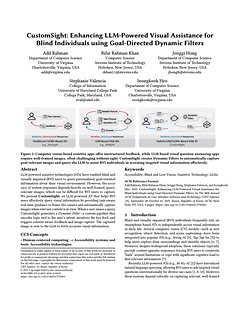
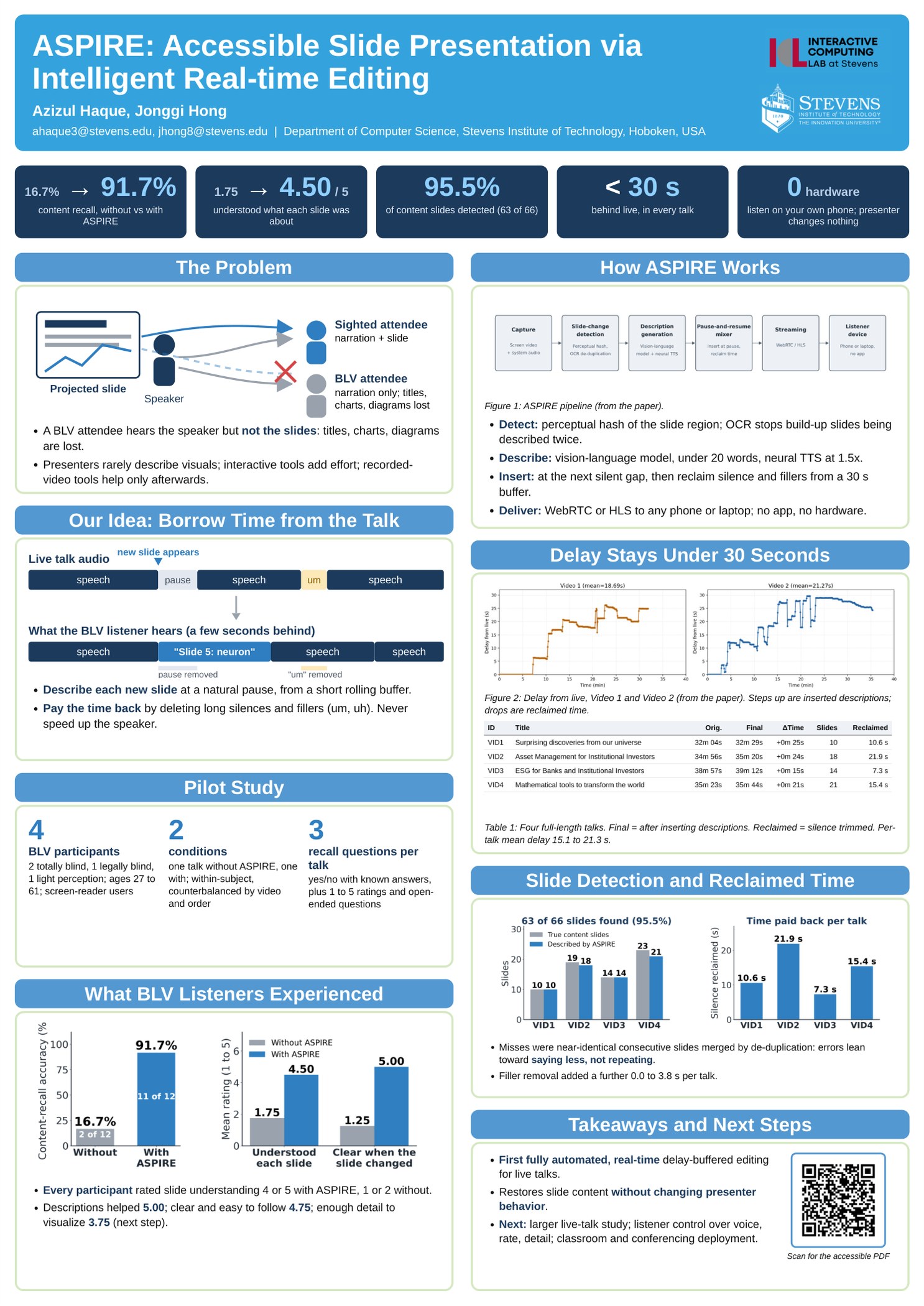
We explore how people interact with technology and how technology can be designed to better support, engage, and empower them. Our research spans human-computer interaction, artificial intelligence, and interactive systems design, with applications ranging from accessibility to education, productivity, and creative expression. Current projects include a smart-glasses assistant that guides blind users through paper forms, intelligent real-time editing that makes slide presentations accessible as they happen, LLM-powered visual assistance with goal-directed filters, and block-based visual tools that make expert domains such as law programmable.

Accessibility is the core driver of our work. Camera-based AI can describe the world, but its errors are hard to detect without sight. We study how blind and low-vision users perceive, verify, and recover from mistakes made by speech recognition, object recognition, and conversational agents, and we build interfaces that put users in control of what the AI does for them. If we build a system for blind users, blind users test it.

We take a user-centered, interdisciplinary approach, combining methods from design, engineering, and the social sciences to create systems that are both technically robust and meaningfully useful. We collaborate closely with end users, industry partners, and researchers at other institutions to ensure our innovations address real-world needs and have lasting impact. Our results appear at the leading venues in accessibility and HCI, including ASSETS, UIST, CHI, and DIS.

Explore our projects below, and get in touch if you are interested in working with us or participating in a study.

Recent News

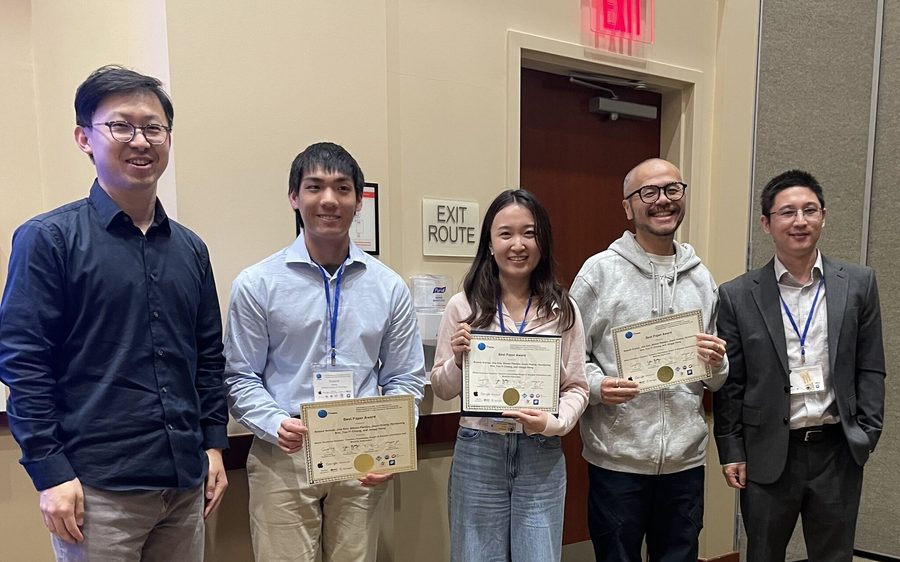
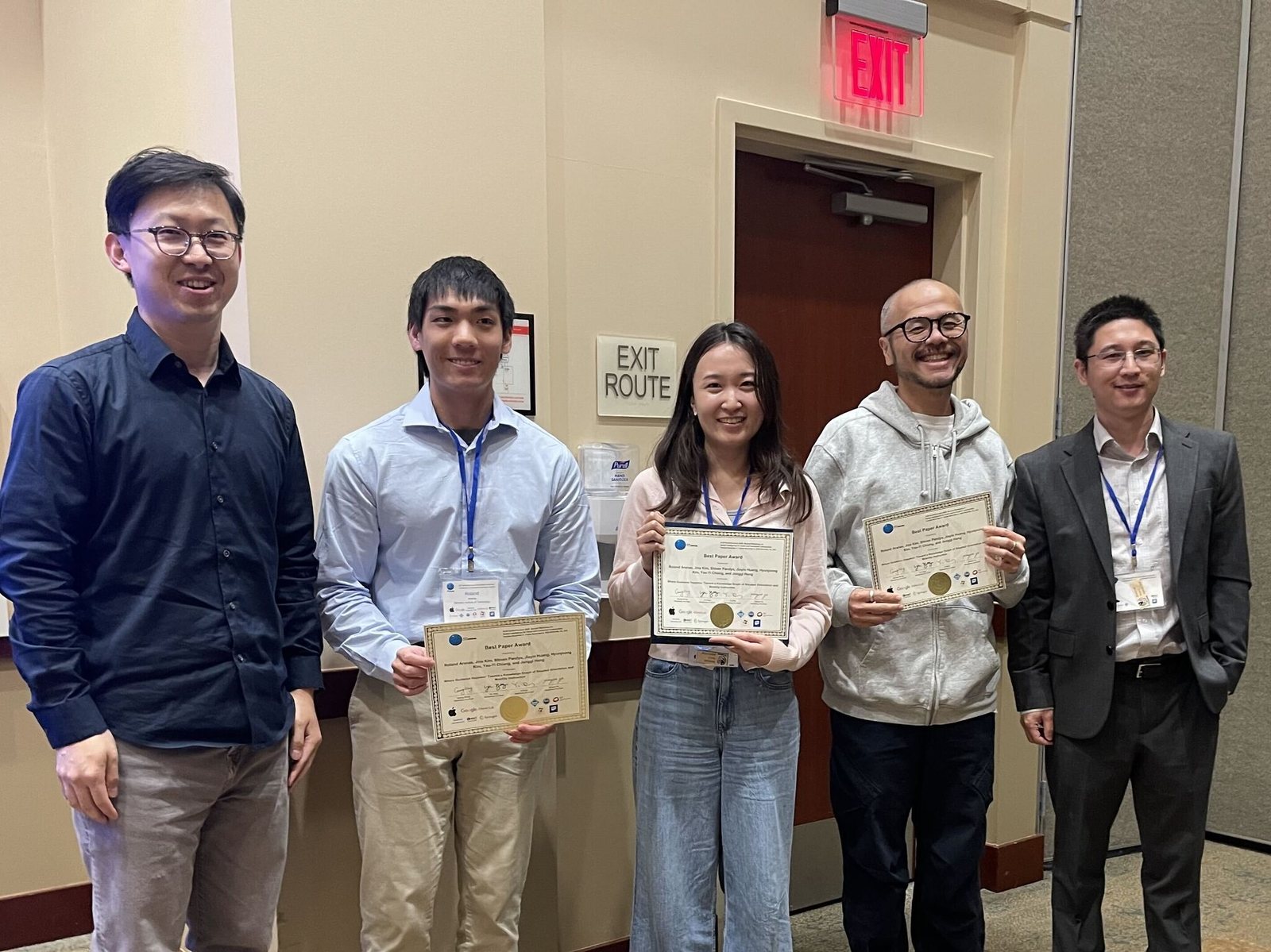
Nov 2026: Where Guidance Happens: Toward a Knowledge Graph of Situated Orientation and Mobility Instruction (Roland Aranas, Shiven Pandya, Jiayin Huang, and Jonggi Hong, with the University of Minnesota) receives the Best Paper Award at SpatialConnect '26, an ACM SIGSPATIAL 2026 workshop in Riverside, CA! Photos
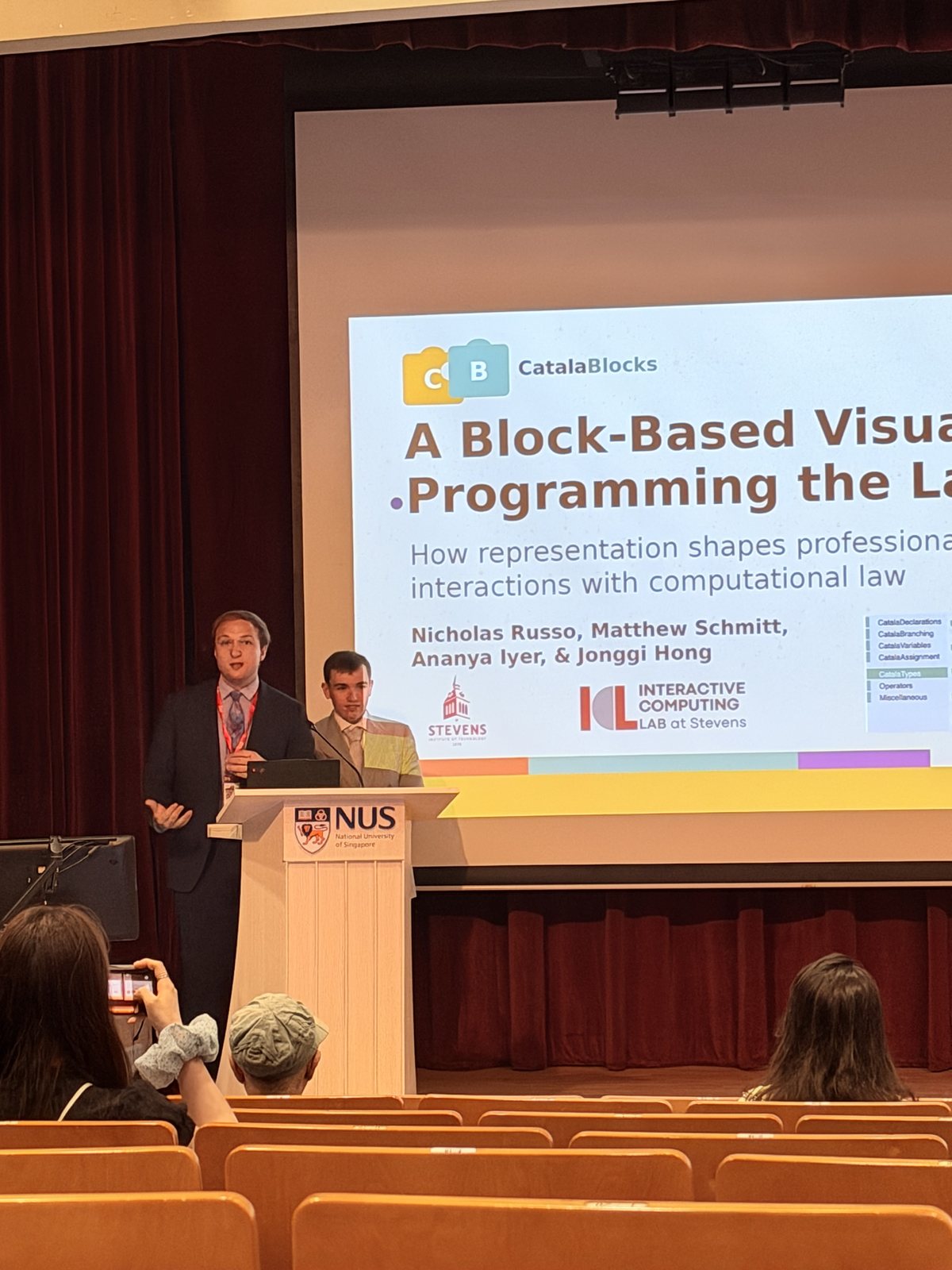
Nov 2026: Nicholas Russo's CatalaBlocks, a block-based visual tool that helps legal professionals without programming experience turn laws into code (DIS 2026), is featured in the "Student Research" column of the Fall 2026 Stevens Indicator magazine (p. 16).
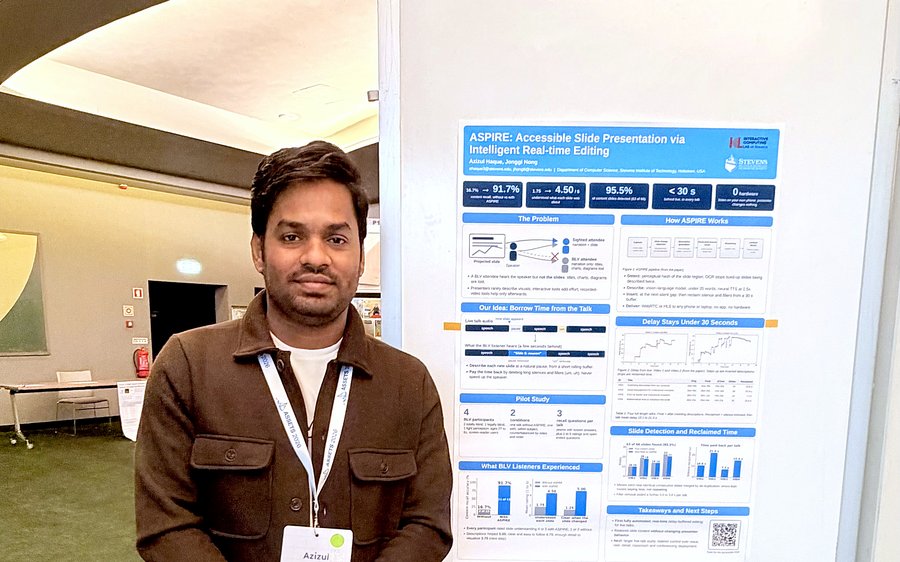
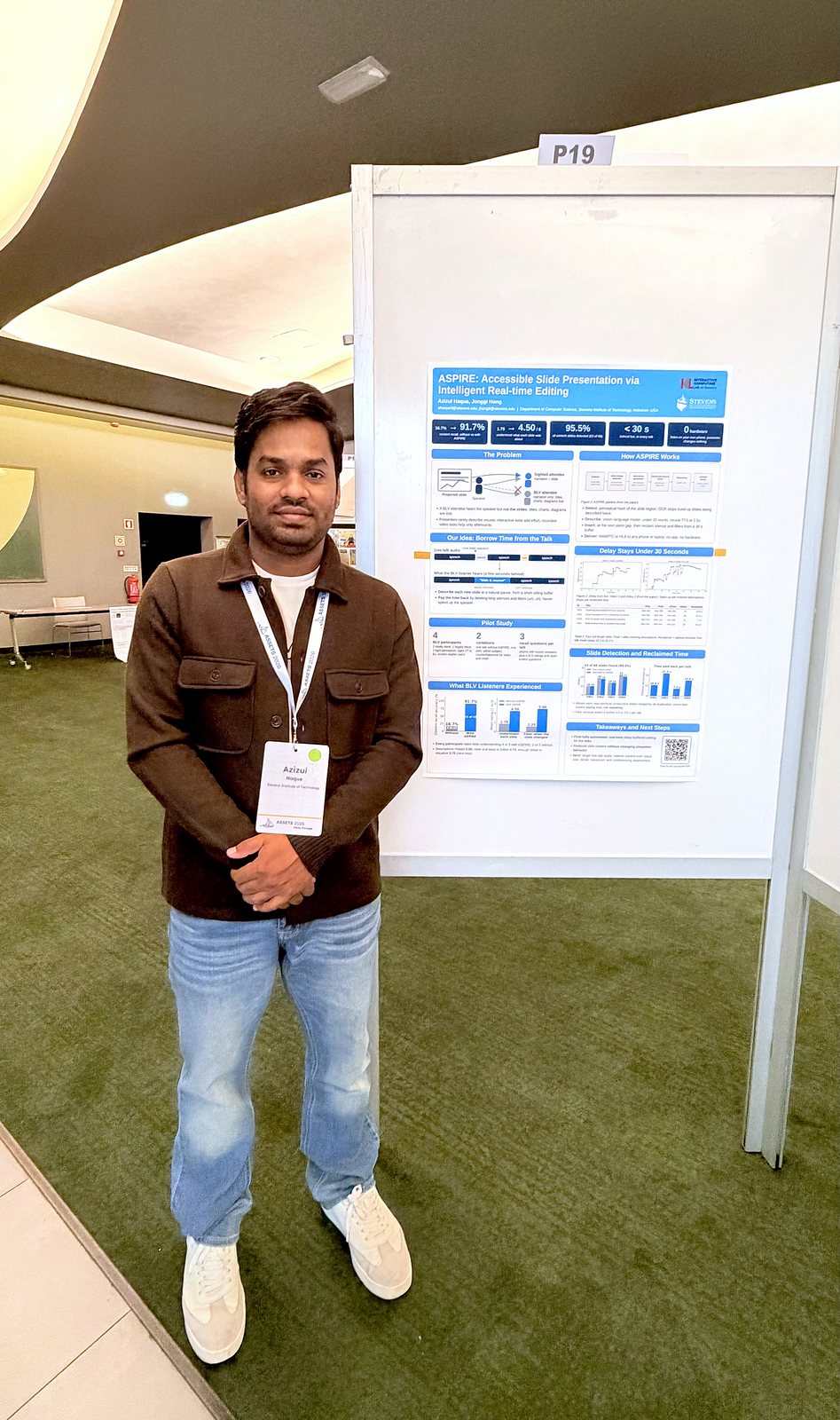
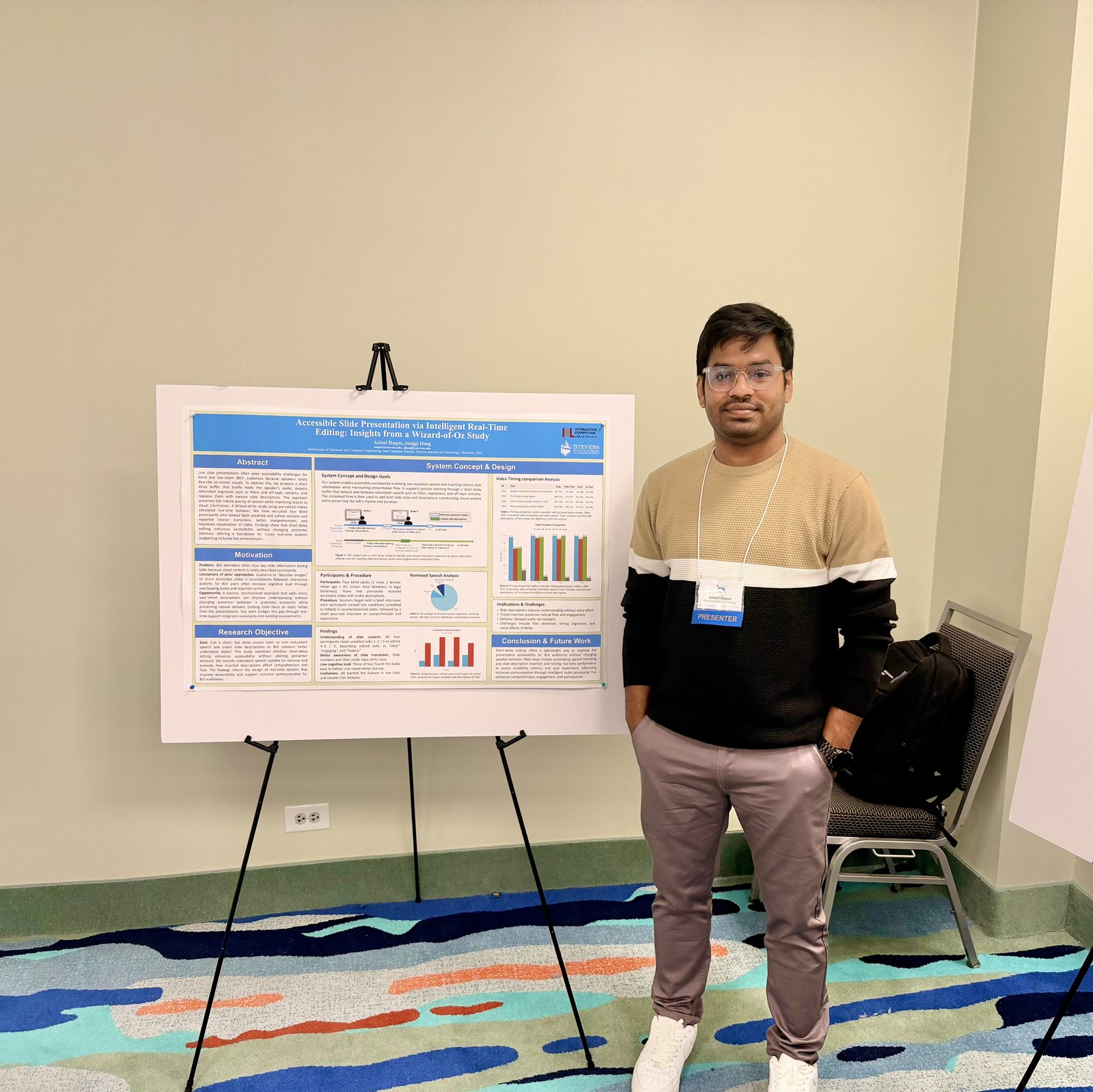
Oct 2026: Azizul Haque presents the ASPIRE poster (Azizul Haque, Jonggi Hong) at ASSETS 2026 in Porto, Portugal, and Rifat Rahman Khan presents the experience report Debugging Computer Vision as a Blind Researcher (Rifat Rahman Khan, Jonggi Hong), reflecting on building the computer vision components of our smart-glasses form-filling assistant as a legally blind researcher. Photos
Sep 2026: Our poster ASPIRE: Accessible Slide Presentation via Intelligent Real-time Editing (Azizul Haque, Jonggi Hong) is accepted to ASSETS 2026 in Porto, Portugal, October 25–28.
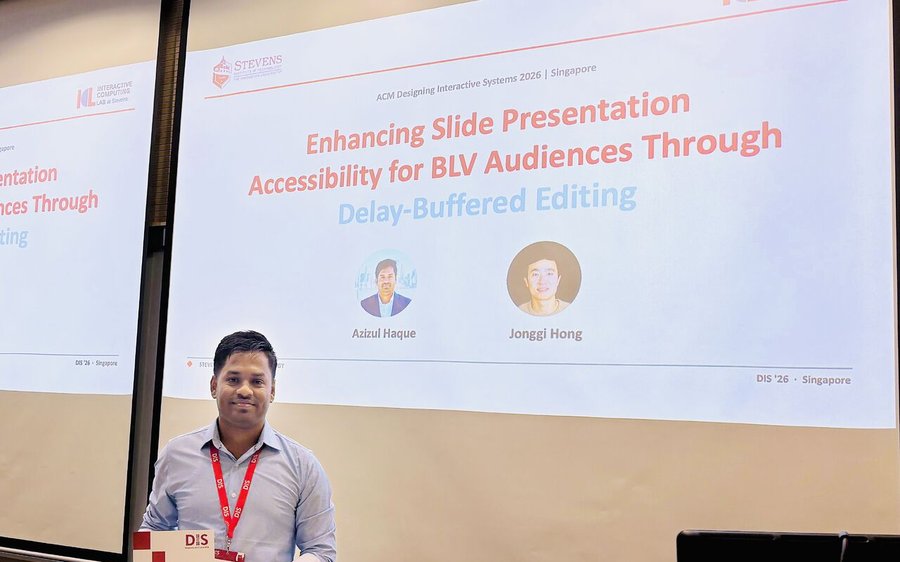
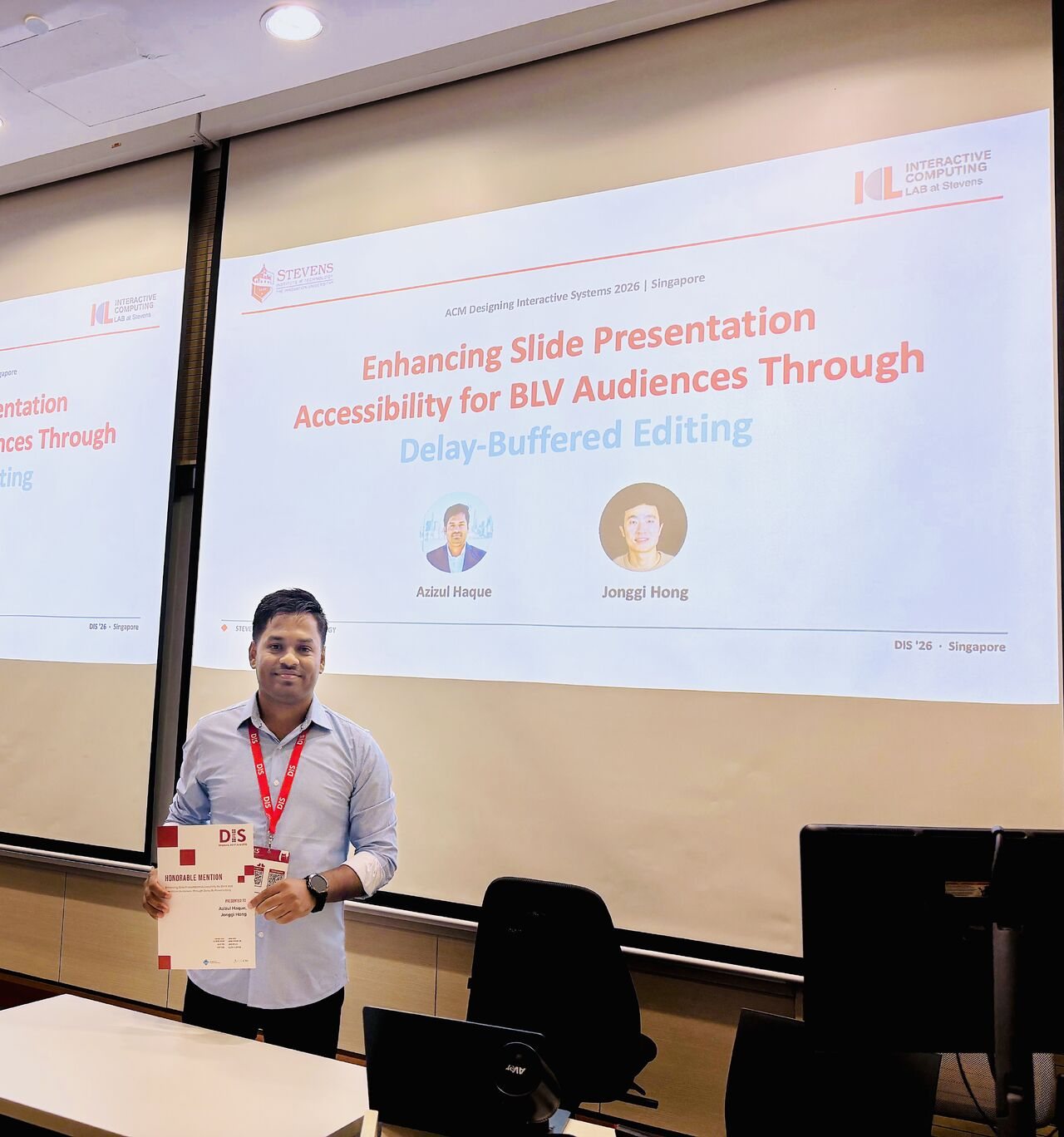
Jun 2026: Enhancing Slide Presentation Accessibility for Blind and Low-Vision Audiences Through Delay-Buffered Editing (Azizul Haque, Jonggi Hong) receives a Best Paper Honorable Mention at DIS 2026! Photos
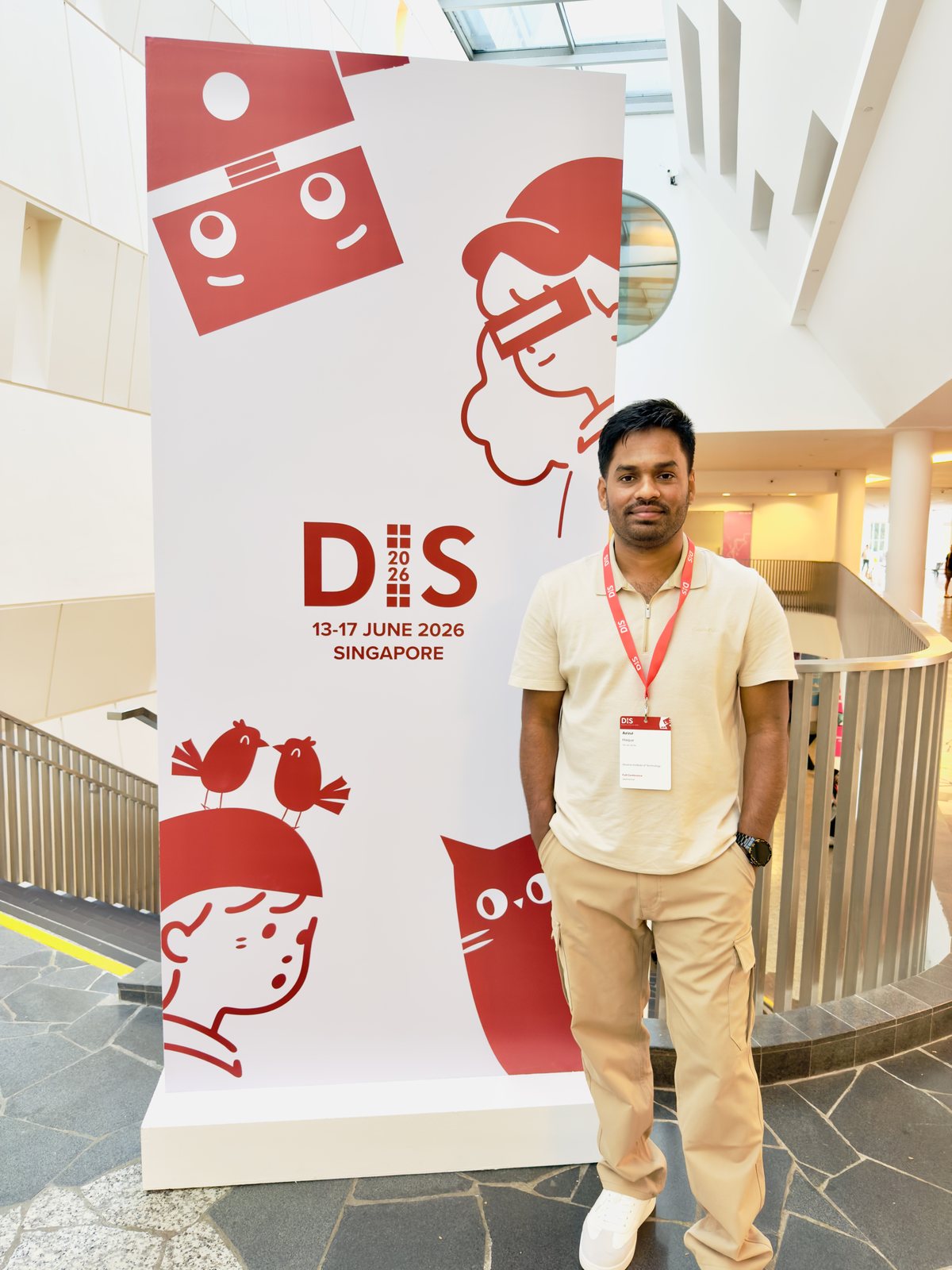
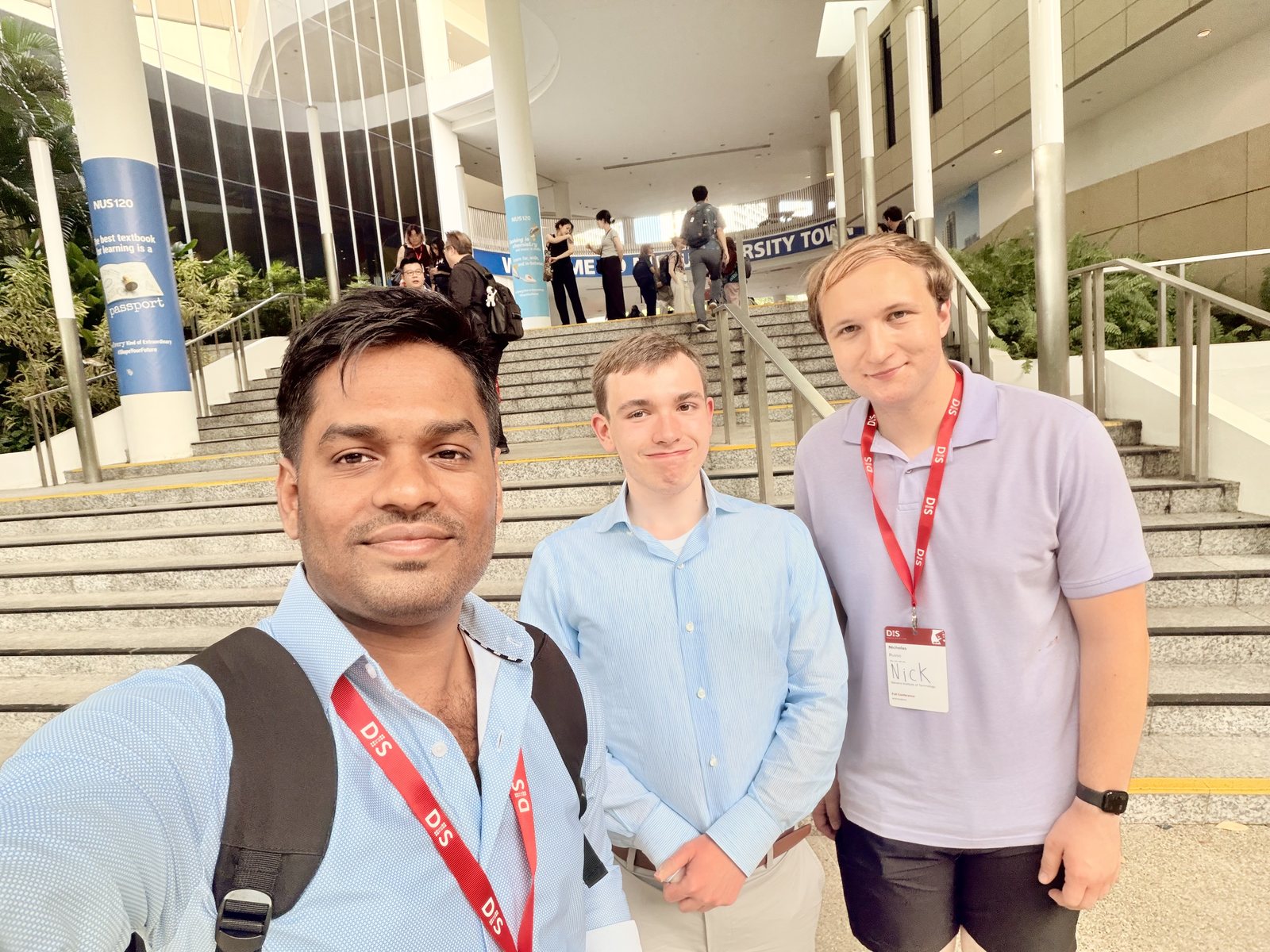
Jun 2026: Two ICL papers are presented at DIS 2026 in Singapore: CatalaBlocks, led by undergraduates Nicholas Russo, Matthew Schmitt, and Ananya Iyer, and Enhancing Slide Presentation Accessibility for Blind and Low-Vision Audiences Through Delay-Buffered Editing by Azizul Haque. Photos
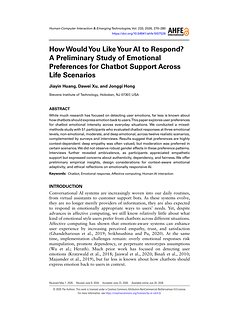
Feb 2026: Jiayin Huang and Dawei Xu's study of emotional preferences for chatbot support is accepted to AHFE 2026.
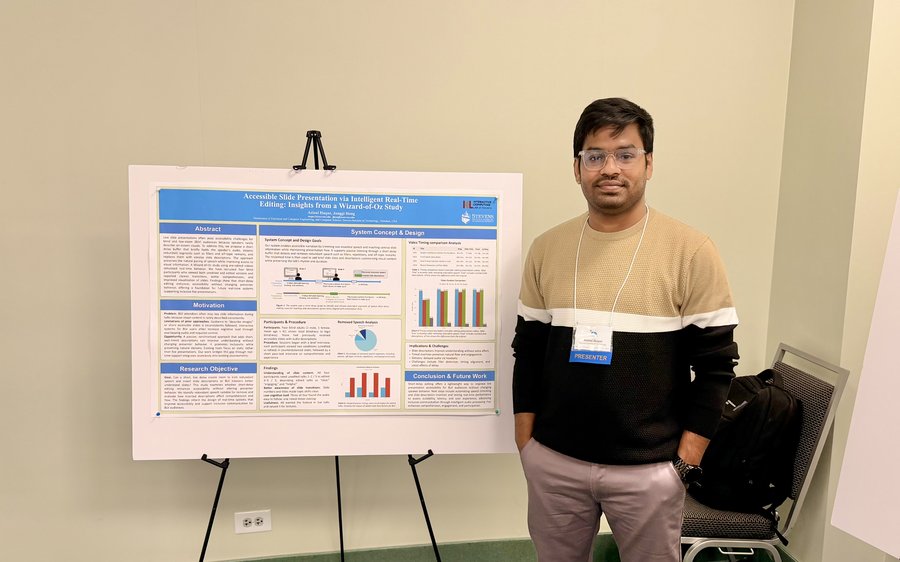
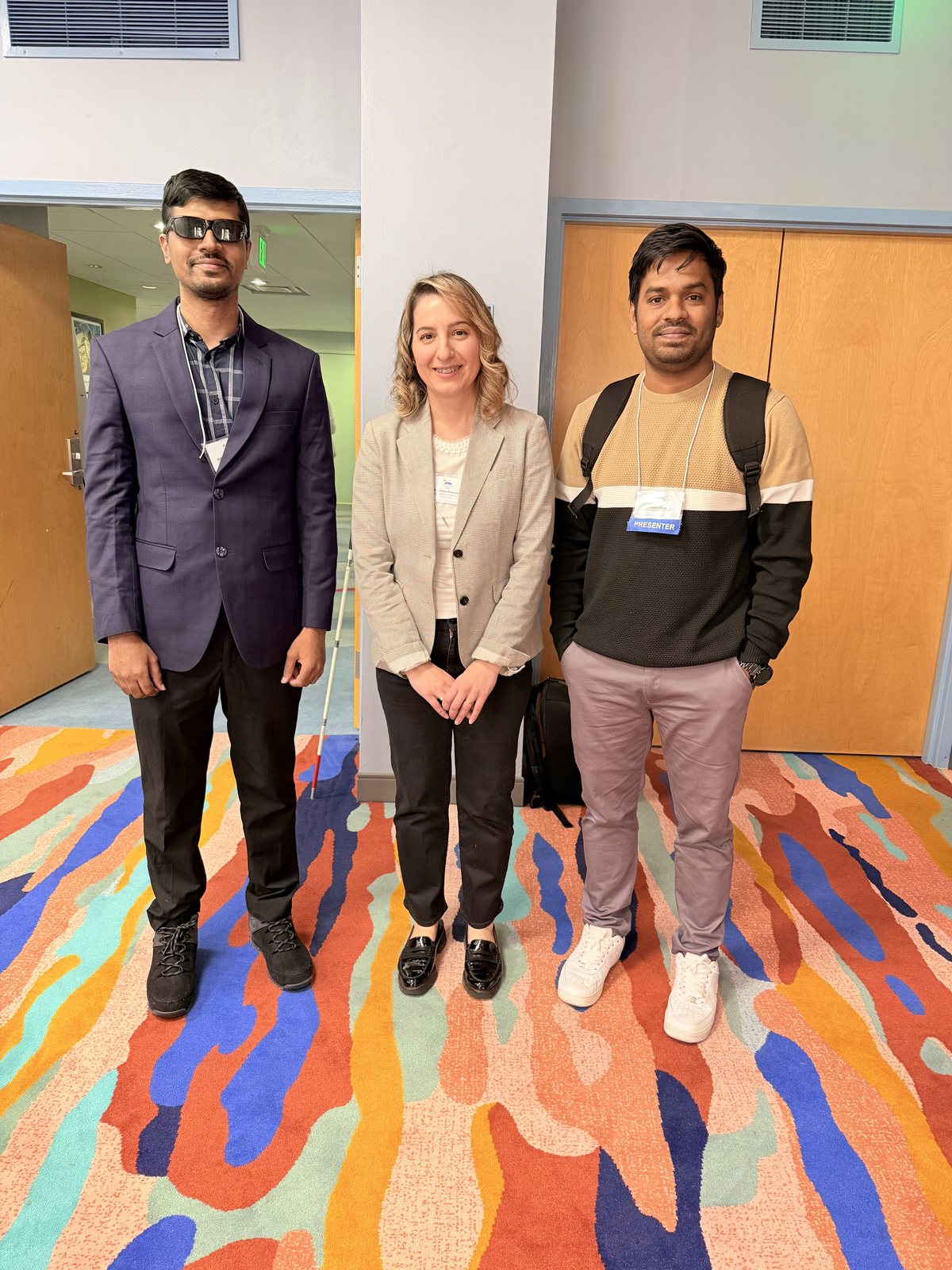
Oct 2025: The lab presents two papers at ASSETS 2025 in Denver: an interactive form-filling assistant on smart glasses (Rifat Rahman Khan, Srikala Sandu) and accessible slide presentations via intelligent real-time editing (Azizul Haque). Photos
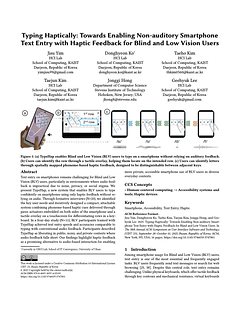
Sep 2025: Typing Haptically, a collaboration with KAIST on non-auditory text entry for blind and low-vision users, appears at UIST 2025. CustomSight, with the University of Virginia, is presented in the UIST adjunct track.
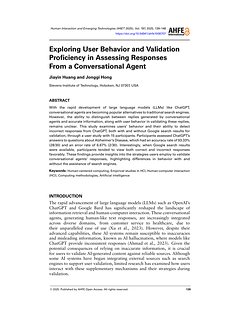
Aug 2025: Jiayin Huang presents work on how users validate conversational-agent responses at IHIET 2025.

Our Team

Headshot of Jonggi Hong
Dr. Jonggi Hong
View profile

Dr. Jonggi Hong

Assistant Professor, Computer Science (Lab Director)
Headshot of Jiayin Huang
Jiayin Huang
View profile

Jiayin Huang

Ph.D. Student, Computer Science
Headshot of Rifat Rahman Khan
Rifat Rahman Khan
View profile

Rifat Rahman Khan

Ph.D. Student, Computer Science
Headshot of Azizul Haque
Azizul Haque
View profile

Azizul Haque

M.Eng. Student, Applied Artificial Intelligence
Headshot of Dawei Xu
Dawei Xu
View profile

Dawei Xu

M.S. Student, Computer Science
Headshot of Srikala Sandu
Srikala Sandu
View profile

Srikala Sandu

M.S. Student, Computer Science
Headshot of Simrat Kaur Randhawa
Simrat Kaur Randhawa
View profile

Simrat Kaur Randhawa

M.S. Student, Computer Science
Headshot of Nicholas Russo
Nicholas Russo
View profile

Nicholas Russo

Undergraduate Researcher, Computer Science
Headshot of Ananya Iyer
Ananya Iyer
View profile

Ananya Iyer

Undergraduate Researcher, Computer Science
Headshot of Matthew Schmitt
Matthew Schmitt
View profile

Matthew Schmitt

Undergraduate Researcher, Computer Science
Headshot of Katherine Espinoza
Katherine Espinoza
View profile

Katherine Espinoza

Undergraduate Researcher, Computer Science
Headshot of Zeynep Alta
Zeynep Alta
View profile

Zeynep Alta

Undergraduate Researcher, Computer Science

Alumni

Headshot of Jiaqi Tu
Jiaqi Tu
View profile

Jiaqi Tu

M.S. Computer Science
Headshot of Ruobing Liu
Ruobing Liu
View profile

Ruobing Liu

M.S. Computer Science
Headshot of Kanika Yadav
Kanika Yadav
View profile

Kanika Yadav

M.S. Computer Science
Headshot of Arnab Chand
Arnab Chand
View profile

Arnab Chand

M.S. Computer Science

Publications

We publish our research in the leading human-computer interaction and accessibility venues, including ASSETS, UIST, CHI, and DIS. Five of our articles have been honored with best paper awards or nominations.

2026

Where Guidance Happens: Toward a Knowledge Graph of Situated Orientation and Mobility Instruction

Roland Aranas, Jina Kim, Shiven Pandya, Jiayin Huang, Hyunjoong Kim, Yao-Yi Chiang, Jonggi Hong

Proceedings of SpatialConnect 2026 (ACM SIGSPATIAL Workshop) Best Paper Award

Debugging Computer Vision as a Blind Researcher

Rifat Rahman Khan, Jonggi Hong

Proceedings of ASSETS 2026 (Experience Report)

ASPIRE: Accessible Slide Presentation via Intelligent Real-time Editing

Azizul Haque, Jonggi Hong

Poster Proceedings of ASSETS 2026

CatalaBlocks: A Block-Based Visual Tool for Programming the Law

Nicholas Michael Russo, Matthew Schmitt, Ananya Iyer, Jonggi Hong

Proceedings of DIS 2026

Enhancing Slide Presentation Accessibility for Blind and Low-Vision Audiences Through Delay-Buffered Editing

Azizul Haque, Jonggi Hong

Proceedings of DIS 2026 Best Paper Honorable Mention

How Would You Like Your AI to Respond? A Preliminary Study of Emotional Preferences for Chatbot Support Across Life Scenarios

Jiayin Huang, Dawei Xu, Jonggi Hong

Proceedings of AHFE 2026

2025

Interactive Form Filling Assistant on Smart Glasses for Blind Users

Rifat Rahman Khan, Srikala Sandu, Jonggi Hong

Proceedings of ASSETS 2025

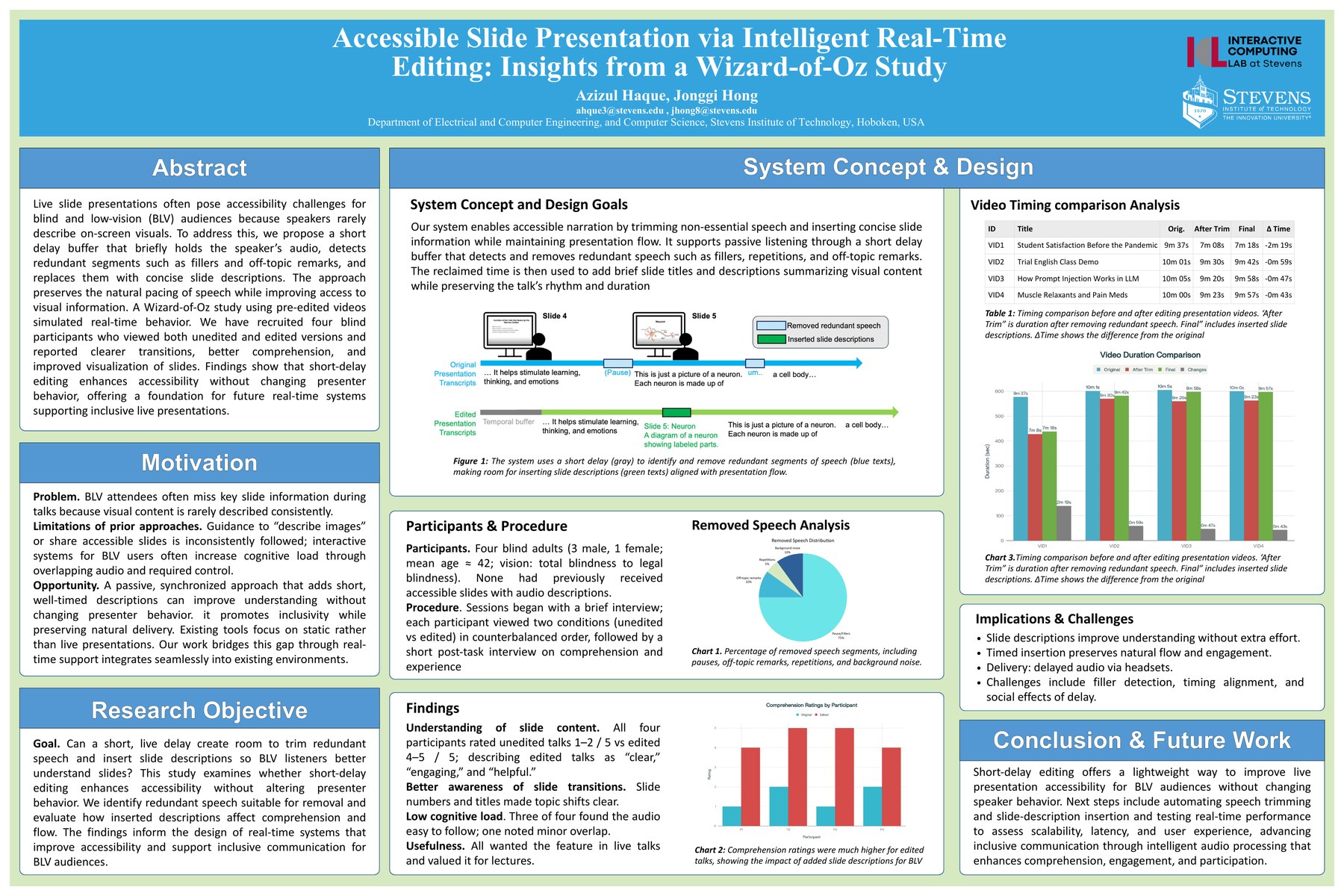
Accessible Slide Presentation via Intelligent Real-time Editing: Insights from a Wizard-of-Oz Study

Azizul Haque, Jonggi Hong

Poster Proceedings of ASSETS 2025

CustomSight: Enhancing LLM-Powered Visual Assistance for Blind Individuals using Goal-Directed Dynamic Filters

Adil Rahman, Rifat Rahman Khan, Jonggi Hong, Stephanie Valencia, Seongkook Heo

Adjunct Proceedings of UIST 2025

Typing Haptically: Towards Enabling Non-auditory Smartphone Text Entry with Haptic Feedback for Blind and Low Vision Users

Jisu Yim, Donghyeon Ko, Taeho Kim, Taejun Kim, Jonggi Hong, Geehyuk Lee

Proceedings of UIST 2025

Exploring User Behavior and Validation Proficiency in Assessing Responses from a Conversational Agent

Jiayin Huang, Jonggi Hong

Proceedings of IHIET 2025

2024

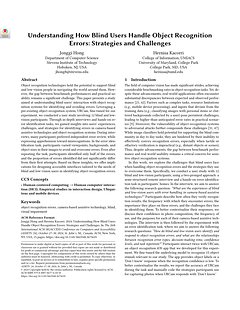
Understanding How Blind Users Handle Object Recognition Errors: Strategies and Challenges

Jonggi Hong, Hernisa Kacorri

Proceedings of ASSETS 2024

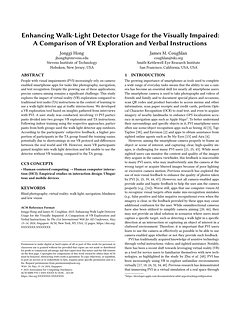
Enhancing Walk-Light Detector Usage for the Visually Impaired: A Comparison of VR Exploration and Verbal Instructions

Jonggi Hong, James Coughlan

Proceedings of W4A 2024 Best Paper Nominee

2023

VR Training to Facilitate Blind Photography for Navigation

Jonggi Hong, James Coughlan

Journal on Technology and Persons with Disabilities (CSUN 2023)

2022

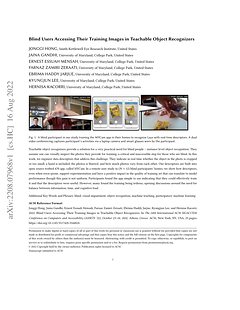
Blind Users Accessing Their Training Images in Teachable Object Recognizers

Jonggi Hong, Jaina Gandhi, Ernest Essuah Mensah, Farnaz Zamiri Zeraati, Ebrima Jarjue, Kyungjun Lee, Hernisa Kacorri

Proceedings of ASSETS 2022 Best Paper Nominee

From the Lab to People's Home: Lessons from Accessing Blind Participants' Interactions via Smart Glasses in Remote Studies

Kyungjun Lee, Jonggi Hong, Ebrima Jarjue, Ernest Essuah Mensah, Hernisa Kacorri

Proceedings of W4A 2022

2021

How Content Authored by People with Dementia Affects Attitudes towards Dementia

Amanda Lazar, Robin N. Brewer, Hernisa Kacorri, Jonggi Hong, Mary Nicole Dugay Punzalan, Maisarah Mahathir, Olivia Vander Hyde, Warren Ross III

Proceedings of the ACM on Human-Computer Interaction (CSCW 2021)

2020

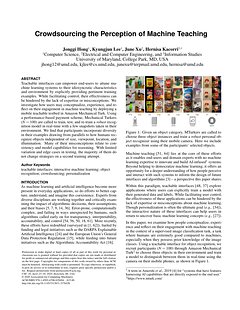
Crowdsourcing the Perception of Machine Teaching

Jonggi Hong, Kyungjun Lee, June Xu, Hernisa Kacorri

Proceedings of CHI 2020

Reviewing Speech Input with Audio: Differences between Blind and Sighted Users

Jonggi Hong, Christine Vaing, Hernisa Kacorri, Leah Findlater

ACM Transactions on Accessible Computing (TACCESS)

2019

Revisiting Blind Photography in the Context of Teachable Object Recognizers

Kyungjun Lee, Jonggi Hong, Simone Pimento, Ebrima Jarjue, Hernisa Kacorri

Proceedings of ASSETS 2019

Exploring Machine Teaching for Object Recognition with the Crowd

Jonggi Hong, Kyungjun Lee, June Xu, Hernisa Kacorri

Extended Abstracts of CHI 2019

2018

Identifying Speech Input Errors Through Audio-Only Interaction

Jonggi Hong, Leah Findlater

Proceedings of CHI 2018

2017

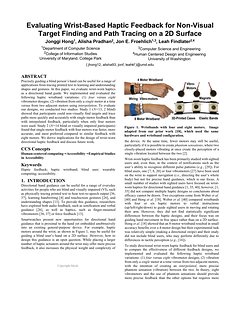
Evaluating Wrist-Based Haptic Feedback for Non-Visual Target Finding and Path Tracing on a 2D Surface

Jonggi Hong, Alisha Pradhan, Jon E. Froehlich, Leah Findlater

Proceedings of ASSETS 2017

2016

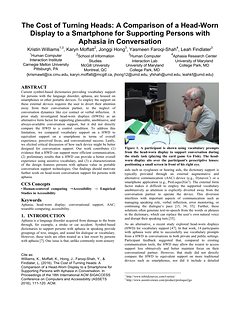
The Cost of Turning Heads: A Comparison of a Head-Worn Display to a Smartphone for Supporting Persons With Aphasia in Conversation

Kristin Williams, Karyn Moffatt, Jonggi Hong, Yasmeen Faroqi-Shah, Leah Findlater

Proceedings of ASSETS 2016

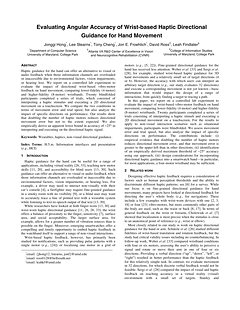
Evaluating Angular Accuracy of Wrist-based Haptic Directional Guidance for Hand Movement

Jonggi Hong, Lee Stearns, Tony Cheng, Jon E. Froehlich, David Ross, Leah Findlater

Proceedings of Graphics Interface (GI 2016)

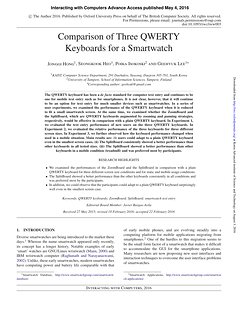
Comparison of Three QWERTY Keyboards for a Smartwatch

Jonggi Hong, Seongkook Heo, Poika Isokoski, Geehyuk Lee

Interacting with Computers (IwC)

2015

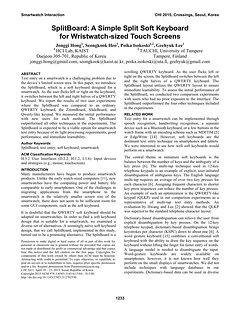
SplitBoard: A Simple Split Soft Keyboard for Wristwatch-sized Touch Screens

Jonggi Hong, Seongkook Heo, Poika Isokoski, Geehyuk Lee

Proceedings of CHI 2015

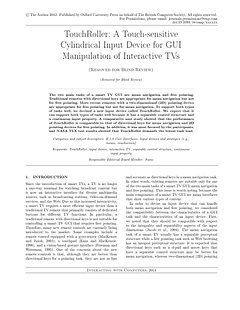
TouchRoller: A Touch-sensitive Cylindrical Input Device for GUI Manipulation of Interactive TVs

Jonggi Hong, Hwan Kim, Woohun Lee, Geehyuk Lee

Interacting with Computers (IwC)

2014

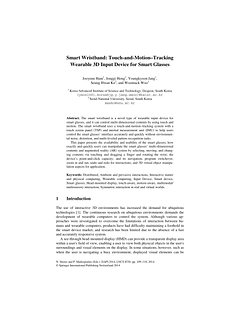
Smart Wristband: Touch-and-motion Tracking Wearable Input Device for Smart Glasses

Jooyeun Ham, Jonggi Hong, Youngkyoon Jang, Seung Hwan Ko, Woontack Woo

Proceedings of HCI International 2014 Best Paper Award

2013

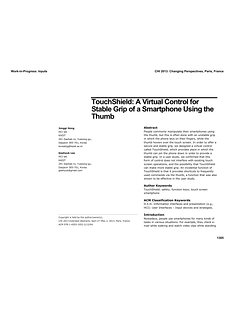
TouchShield: A Virtual Control for Stable Grip of a Smartphone Using the Thumb

Jonggi Hong, Geehyuk Lee

Extended Abstracts of CHI 2013

Classes Taught by Dr. Hong

CS 545: Human-Computer Interaction

An introduction to human-computer interaction: basic concepts, principles, and frameworks in HCI; models of interaction; and design guidelines and methodologies. Students learn how to study users, prototype interactive systems, and evaluate them with real people, and they work in teams on a semester-long project that culminates in an original contribution to the field. Accessibility and inclusive design run through the whole course.

Read more →

CS 541: Artificial Intelligence

A graduate-level introduction to artificial intelligence that emphasizes both learning and problem solving. The course develops rigorous statistical models for real-world AI applications and covers modern optimization techniques for finding an optimal model for a given problem, with attention to how people interact with, trust, and correct AI systems.

Read more →

Videos

Lab Openings

Prospective PhD students: We are looking for motivated PhD students interested in human-computer interaction, accessibility, and human-AI interaction, in particular (1) accessible AI and visual assistance for blind and low-vision people and (2) wearable and non-visual interaction with smart glasses and haptics. Please see our research focus. If you believe you are the right fit, apply to the Stevens Computer Science PhD program, name Dr. Hong in your statement, and email him at jhong8@stevens.edu with: (1) a brief description of yourself and your skillset, supported by relevant prior experience, (2) some examples of projects you'd like to pursue in your PhD, and (3) your CV. We look forward to hearing from you!

Undergraduates/Masters students: Current Stevens students can join the lab for an independent study, a thesis, a senior design project, or a research assistantship when funding is available. Many of our recent papers are led by master's and undergraduate students. Please email Dr. Hong with your year, program, relevant coursework, and the research area that interests you, using the subject line "[Student Research] Your Name".

Study participants: Our research depends on people who use assistive technology every day. We regularly run studies with blind and low-vision participants, in person in Hoboken, NJ and remotely, and participants are compensated for their time. If you would like to hear about upcoming studies, email Dr. Hong with "Study participation" in the subject line.

Contact: Dr. Jonggi Hong, Gateway Center S252, Stevens Institute of Technology, 1 Castle Point Terrace, Hoboken, NJ 07030. jhong8@stevens.edu · LinkedIn